How Professional Home Cinema Tuning Transforms Sound
How Professional Home Cinema Tuning Transforms Sound
 y double
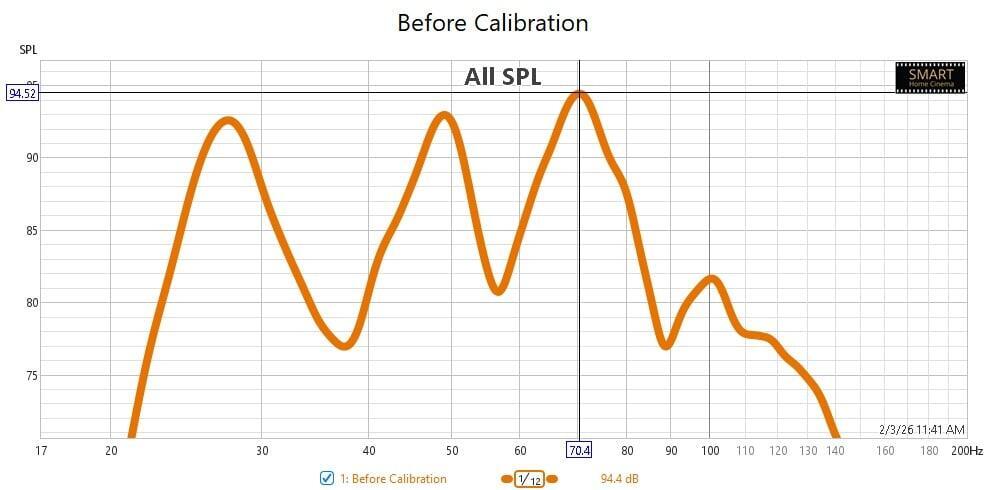
The REW measurements shown here clearly demonstrate why professional audio calibration is essential in a high-performance home cinema. The “Before Calibration” graph reveals a response dominated by the room rather than the system. Large low-frequency peaks and deep cancellations indicate strong room modes, while the uneven mid-bass and lower midrange response would result in boomy bass, inconsistent impact, and reduced dialogue clarity. Even with quality equipment, this type of response leads to listening fatigue and a lack of tonal accuracy, especially during dynamic movie playback
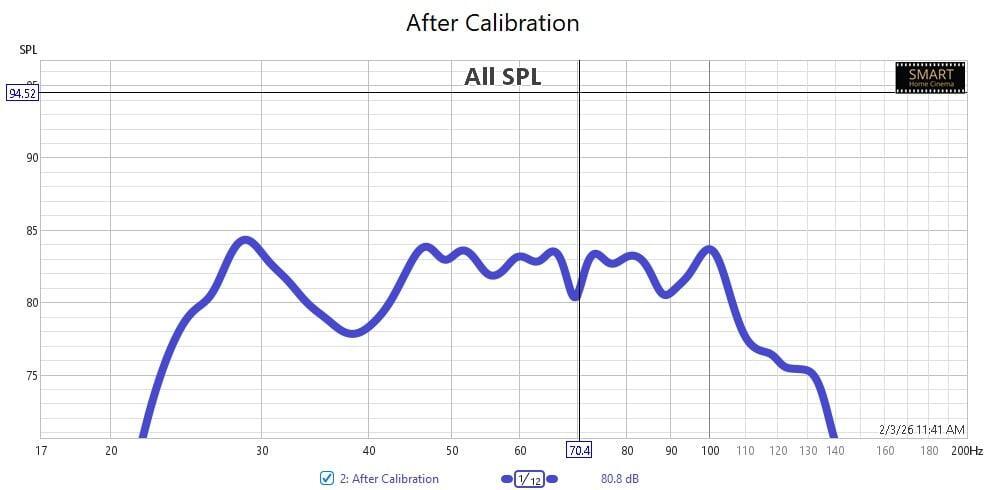
After calibration, the improvement is immediately evident. The “After Calibration” measurement shows a significantly smoother and more controlled frequency response across the critical listening range. Major peaks have been reduced, bass energy is better distributed, and the transition through the crossover region is more coherent. This was achieved through precise level matching, time alignment, phase optimization, and targeted equalization based on measured data—not presets or automatic correction alone. Importantly, the goal was not to force the system into an artificially flat response, but to achieve a balanced, natural curve that preserves impact while improving clarity and consistency.
Calibration is not about changing the character of the speakers, but about removing the room’s distortion so the system can perform as intended. When done correctly, the benefits are audible—cleaner dialogue, tighter bass, smoother transitions, and a soundstage that remains immersive and comfortable even at reference levels. These measurements are a practical example of how disciplined, measurement-driven calibration transforms a good system into a truly cinematic experience.
Final Conclusion
The before-and-after measurements clearly demonstrate that audio calibration is not an optional upgrade, but a fundamental part of serious home cinema design. Without calibration, even high-quality systems are dominated by room acoustics, resulting in uneven bass, compromised clarity, and reduced immersion. After proper measurement-based calibration, the system behaves in a controlled and predictable manner, delivering consistent tonal balance, improved dialogue intelligibility, and tighter low-frequency performance across the listening area.
This process goes beyond automatic correction or preset-based tuning. Professional calibration combines accurate measurement, informed interpretation, and careful adjustment to ensure the system performs as a cohesive whole within the room. When executed correctly, calibration does not change the character of the system—it reveals it. These results underline why precision audio calibration is essential for achieving a truly cinematic experience that is both impactful and comfortable at real listening levels
- All measurements were taken using a four-microphone spatial measurement method, capturing the acoustic behavior across the listening area. Calibration decisions were based on spatial averaging, time alignment, phase optimization, and controlled equalization using REW software.
- This level of calibration is intended for high-performance home cinema environments where accuracy, realism, and long-term listening comfort are priorities